Advertisement

Showing posts with label server. Show all posts

Saturday, 18 April 2015

AMD Exits Dense Microserver Business, Ends SeaMicro Brand


AMD’s Q1’15 earnings announcement just came out a bit ago, and while we’re still waiting for the analyst call to take place to get more details, there is one item we want to get to right away, and that’s the fate of AMD’s dense server business. As part of today’s earnings release, AMD has announced that they’re existing the dense server system business – operating under the SeaMicro brand – effective immediately.

AMD initially acquired SeaMicro back in 2012 for $334 million as part of their larger play into being an agile company, aiming to take a big chunk of what was expected to be a fast-growing market micro/dense server market. In the microserver model, servers are built using very large numbers of lower performance cores, making the servers leaner, more power efficient systems for tasks that involve large numbers of low-impact threads (think: web servers). This in turn mapped well to AMD’s processor designs, where both the Bulldozer and Cat families would be well suited for such a design, not to mention AMD’s future ARM based CPUs.


SeaMicro’s first product post-acquisition was the SM15000, a dense server design announced in late 2012 that offered either AMD “Piledriver” Opterons or Intel “Ivy Bridge” Xeon CPUs. However as it turns out that first design was also the last design; SeaMicro did not release any additional products prior to today’s announcement from AMD.

Jumping back to today, AMD’s announcement comes as the company is continuing to try to find a solid foothold as a semi-custom silicon company, to which it would appear that the SeaMicro business no longer fits into. AMD’s initial announcement does offer a bit of insight as to why they’re exiting the business – to “sharpen and simplify” what the company invests in –  and we’ll likely hear more on today’s call.

Meanwhile it’s worth noting that we haven’t heard anything from SeaMicro in some time now, so today’s announcement is perhaps not all that surprising. Still, AMD’s first ARM processors were set to ship this year – the Opteron A1100 – which would have been a good fit for the SeaMicro servers. However A1100 itself appears to be behind schedule at this time, as AMD has yet to bring A1100 to market beyond last year’s development kit.
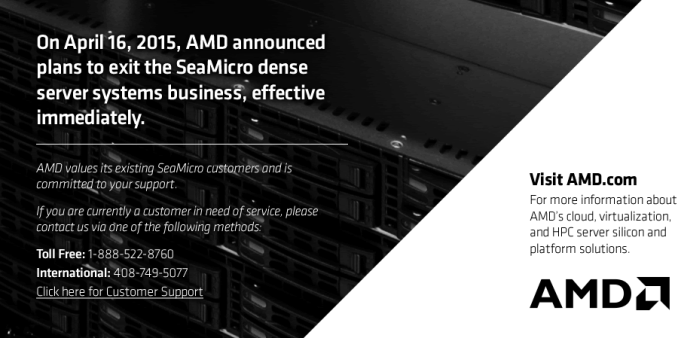

Anyhow, as part of exiting the dense server business, AMD will be taking a $75 million dollar special charge, which is “primarily related to impairment of previously acquired intangible assets” and will include a $7 million cash payment. Meanwhile AMD’s announcement doesn’t say what will become of the SeaMicro team – at this point we’re not entirely sure how large it is after AMD’s most recent restructuring – though I wouldn’t be surprised if they at least rolled some of that expertise into future ARM server CPUs. As for the SeaMicro brand itself, with AMD’s exit the brand has been shuttered, and AMD has deactivated the SeaMicro website.

Friday, 17 April 2015

Walmart, BoA Are Top IT Spenders

The world's largest companies spent about $895 billion on technology in 2014, according to research firm IDC.

The top 10 IT spenders accounted for $45.3 billion of that total. At nine out of ten of those companies, technology spending rose between 2 and 10 percentage points in 2014, compared to 2013.

IDC's study, "The Big Guns: IDC's Worldwide Top Ten IT Spenders," identifies Walmart Stores as the top IT spender. The retail giant spent $10.16 billion on IT in 2014, a 3.1% increase from the $9.86 billion it spent in 2013.

Second-ranked Bank of America spent about half what Walmart spent on IT in 2014, $5.33 billion, but its spending growth percentage, at 6.2%, was roughly double Walmart's.

Citigroup, AT&T, and JPMorgan Chase represent the remainder of the top five. IDC's study indicates that, on average, about a third of the technology spending by these companies goes toward salaries and benefits for internal IT and telecommunications staff.

IDC program director Jessica Goepfert said in an email that the largest companies are spending on a combination of customer-facing and enterprise-focused projects, along with initiatives to adopt and advance third-party platform technology.

"This indicates that companies recognize the imperative to implement innovative technologies to remain competitive while balancing necessary investments to 'keep their houses' in order," said Goepfert.


Bank of America, said Goepfert, has retired more than 18,000 applications since 2010 to simplify and modernize its platform. "Meanwhile, the company is also utilizing big data to help with its customer retention efforts," she explained. "This includes, in part, a consolidated central analytics group to foster more transparency and communication across channels for a smoother customer experience."

Among financial services and retail companies in particular, said Goepfert, mobile technology initiatives aim to meet customer needs. "Walmart, for instance, is very focused on mobilizing the store," she said. "The company claims it was the first retailer to launch geo-sensitive functionality that changes the user interface of its customer-facing mobile application when a shopper enters the store."

Goepfert pointed to Nordstrom as another large retailer that manages to be innovative in terms of IT. The company, she said, has found ways to use technology in the service of its mission: to provide a great customer experience. "There are a variety of examples -- from its point-of-sale system, to different apps it has launched," she said. "What is unique is that the company, despite its size, seems to be able to execute its strategy in a cohesive, integrated fashion."

Friday, 27 March 2015

ARM to have 20% of 2020 server IC market

ARM reckons it may have a 20% share of the server IC market in five years time.

ARM’s vp of investor relations told a meeting in Taipei that ARM’s market share was now less ghan 1% and Intel’s share of the server chip market is 90%.

He said that Intel’s ASP for a server chip is $600 while the cost of an ARM server chip is $100 to $200.

Moor Insights say that, over three years, the cost of buying and running ARM servers could be 35% less than x86 and they use two thirds the number of physical racks.

Canaccord reckon ARM server CPUs will have a 20% share of the server chip market by 2018.

ARM saw server chip revenues for the first time last year.

HP brought out two ARM-based servers – the ProLiant M400 with a 2.4GHz ARMv8-based Applied Micro X-Gene eight-core SoC and M800 which has a 32-bit Texas Instruments quad-core 1GHz ARM Cortex-A15 with eight DSP cores.

The M800 is aimed at “businesses wanting VOIP/LTE, seismic processing and/or real-time video transcoding while saving on energy, space and cost,” says HP.. Customers for it include the US Department of Energy’s Sandia National Labs and the University of Utah. The M400 is for tasks like web caching and PayPal is one customer for it.

Four chip-makers have announced 64-bit ARM v8 chips to go into the server and networking markets.

The Big Beast is the 48 core v8 64-bit 2.5GHz Cavium processor called ThunderX. “ThunderX will enable Cavium to be the first ARM-based vendor to deliver the performance and features required by today’s volume server market at half the power and significantly lower cost compared to competing solutions,” says processor guru Linley Gwennap.

As well as ThunderX, there’s Applied Micro’s eight v8 core X-Gene processor and AMD’s eight v8 core Seattle processor.

In January, Iliad, the French provider of telecommunications services, launched a cloud service based on ARM-based servers which it has built in-house using Marvell chips.

18 servers – each with a quad-core CPU – can fit onto a blade, and 16 blades can fit in a chassis.

Friday, 13 March 2015

Intel to ship built-to-order Xeon D chips in second half

Intel will start offering custom chips based on the Xeon D starting in the second half of this year, making it easier to tailor servers to process specific workloads.


Intel this week announced Xeon D chips for servers, storage and networking, but the four- and eight-core chips have a fixed set of components and features. The built-to-order chips later this year will be tailored to customer specifications, and to needs in storage, networking and web serving.

For example, Intel will be able to customize chips to include components such as FPGAs (field-programmable gate arrays), which are reprogrammable chips used for specific tasks. For example, Microsoft uses FPGAs in servers to boost the accuracy of search results in Bing. Bringing FPGAs inside Xeon D could make the chip more versatile.


“The Xeon D product family will offer many options for customization,” said Lisa Spelman, director of data center product marketing at Intel, in an email.

Intel already provides custom server chips to large customers like Facebook and eBay, which are building mega data centers to handle their sites’ and services’ growing load of web transactions. Many of the chip tweaks are minor, based on frequency, power draw and I/O capabilities. Customizing chips helps squeeze more power efficiency and performance from servers in data centers.

The Xeon-D is Intel’s first “system-on-chip” server chip, meaning there’s a wider array of components packaged inside a chipset alongside the CPU. Some of those components are related to storage and networking, but there’s a lot more flexibility to replace parts and customize. For example, incorporating a power hungry FPGA may result in the removal of some components to keep the power draw of Xeon D within reasonable limits.

Xeon D chips are meant for dense servers, but may also go into robots, which need more processing muscle for industrial tasks such as manufacturing and quality control. Another target for the server chip is Internet of Things systems, which must process large amounts of data from sensors and mobile devices.

Xeon D is Intel’s first server chip made using the Broadwell microarchitecture, which is already being used in PC chips.