Advertisement

Showing posts with label qualcomm. Show all posts

Saturday, 28 November 2015

Qualcomm Shows Off Prototype ARM Server Chip

qualcomm-arm-chip-bw
Nearly a year ago at an analyst day event in New York, Qualcomm, the largest maker of ARM chips aimed at smartphones, told the world that it had aspirations for the big machines that feed those smartphones their data and applications and jumped into the 64-bit ARM server fray.
Today, Qualcomm showed off the first fruits of its ARM server labors, which the company divulged actually began more than two years ago, and that is a prototype chip that is intended for early adopters – presumably hyperscale customers who are always looking for a computing edge. The company also committed to delivering a production-grade ARM server chip as fast as it can without committing to a particular time.
Like other suppliers in the nascent ARM server space, Qualcomm has kept mum about its future server chips and roadmaps. But the revelation of a working pre-production version of an ARM server chip, and that it plans to come out next year with a beefier production chip that it says will compete against other ARM suppliers and the Xeon processors that currently rule the datacenter, is meant to show that Qualcomm is serious about getting into the datacenter. The partnerships that Qualcomm announced with networking chip and switch maker Mellanox Technologies and FPGA maker Xilinx are a significant part of the company’s plans for the data center – and echoing IBM’s own OpenPower Foundation partnerships that started out with Mellanox and Nvidia for networking and accelerated compute and that now include Altera and Xilinx. (With Intel buying Altera, it is reasonable to expect that Xilinx will play a key role with non-Xeon chip suppliers.) Qualcomm did not announce a partnership for GPUs with Nvidia and did not answer questions on that topic, but a partnership could happen in the future.
Given the intense competition between all ARM chip designers and the financial and market might that Intel can bring to bear against any competitor, Qualcomm is understandably hesitant to talk much about its server development platform, which is now sampling to tier one datacenter customers, according to Anand Chandrasekher, general manager of the Datacenter Group at the Qualcomm Technologies division of the chip maker. This division, created in 2012, is where Qualcomm does its open source projects and other developments where it wants to share intellectual property.
Qualcomm is not disclosing the core design or other attributes of its 64-bit ARM server chip except to say that it hews to the ARMv8-A specification from ARM Holdings and that it has 24 cores. Qualcomm is not revealing what process technology it is using to make the prototype chip or any details on clock speeds, cache memory, main memory, on-chip controllers, and other features, and it is not talking about its code-name, either. What the company is saying is that it will deliver a production-grade ARM server chip using an advanced FinFET 3D transistor process that will have more cores than the pre-production chip showed off today.
Qualcomm did not talk about who its fab partner was for the pre-production ARM server chip or for the production version that is coming out in the future, but Vinay Ravuri, vice president of product management in the Datacenter Group and formerly general manager of server products at Applied Micro, which is trying to ramp its X-Gene 64-bit ARM server chips, says that Qualcomm has historically used Taiwan Semiconductor Manufacturing Corp and Samsung, which have fabs in Taiwan, and Semiconductor Manufacturing International Corp, which runs fabs in China, as partners for its cell phone and other chips. It is reasonable to expect one of these vendors is making the as-yet-unnamed ARM server chips
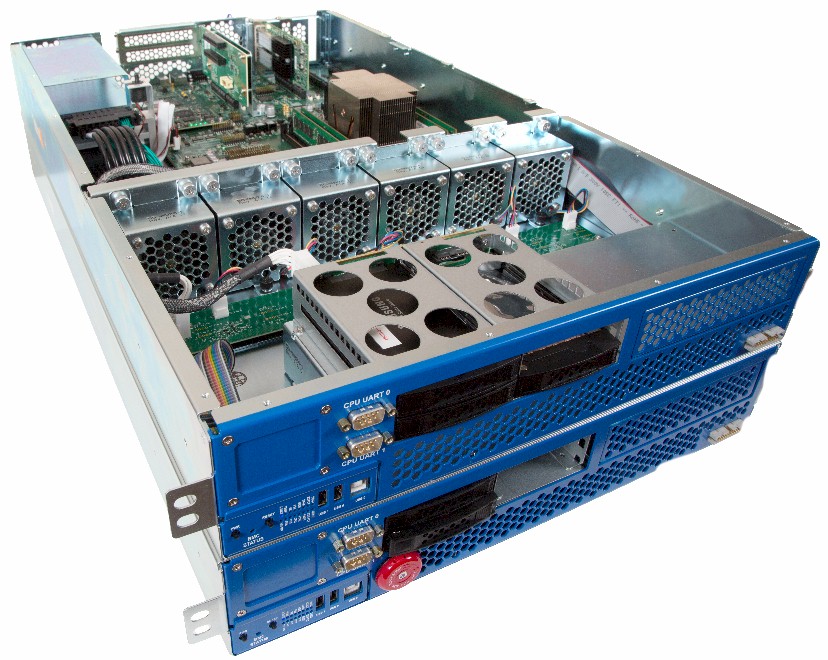
Rather than just trot out a presentation, the Qualcomm Datacenter Group team trotted out a stack of three of its server development platform machines at a meeting in San Francisco. The nodes were shown running a an open source Linux operating system with the 2.4 kernel, all orchestrated by the OpenStack cloud controller and using the KVM hypervisor to load up a standard Linux distribution and run a WordPress content management system fronted by the Apache web server. Ravuri tells The Next Platform that Qualcomm will put bits of code upstream in the Linux kernel to support its ARM server system-on-chip features and the modified ARM cores it has created for the chips, and that eventually the key Linux distributions will be enabled to support the Qualcomm processors.
qualcomm-arm-server
ARM Holdings licenses designs for ARM cores, interconnects, and other components of a system-on-chip to chip makers who in turn modify them for their own uses. This ability to have code portability while allowing customization is why ARM Holdings has hundreds of licensees for its technology. That enthusiasm for the malleability of chips in the ARM ecosystem, more than anything else, is why Intel is providing custom chips to hyperscale datacenter operators, cloud providers, and certain system makers. It is also why Intel is keen on learning how to make system-on-chip designs that are common in the client and networking areas where many of the ARM server chip makers are coming from.
Like AMD, Applied Micro, Broadcom, and Cavium Networks, Qualcomm is a full licensee of the ARMv8 architecture, and that means it can and does make its own cores rather than use the Cortex-A53, Cortex-A57, and Cortex-A72 cores that ARM develops itself for those who don’t want to make their own cores. (They all have to support the ARMv8 instruction set, of course.) Everyone is probably expecting that this ARM server chip is really just a variant of the Snapdragon 820 processor, with the “Kryo” core design, that was just announced for client devices, but this is apparently not the case.
“The chip we demonstrated today us based on Qualcomm purpose-built cores, they are not a licensed core,” Ravuri confirmed. “This is not based on the Snapdragon 820, these are server custom chips, and even the cores are server-specific cores, and are not mobile cores as the 820s are.” Ravuri cannot say much about the performance of the current prototype Qualcomm ARM server chip or the future one, but did say that “the future Qualcomm chip will be competitive in performance and price with current and future Intel chips.” As for the timing, Ravuri said it would be “sooner rather than later” but that he “can’t say when.”
That would be the current “Haswell” Xeon E5 v3 processors, launched in September 2014, and the future “Broadwell” Xeon E5 v4 processors, widely expected sometime in the spring of 2016. To be competitive with Intel means getting the future, production Qualcomm server chip out the door in 2016. This is when the other ARM suppliers for servers will also be ramping.
At the moment, the prototype ARM server chip from Qualcomm is limited to a single socket, and for many workloads, particularly at hyperscalers, that is fine so long as that socket has enough oomph and memory. But Ravuri conceded to The Next Platform that Qualcomm and its early adopter customers foresee the need for symmetric multiprocessing (SMP) clustering of processors together for certain workloads using ARM chips. Thus far, the ThunderX chip from Cavium Networks is the only ARM supplier with two-way SMP. The point is, SMP is definitely on the Qualcomm roadmap, although precisely when it might appear is unknown.
Designing a chip is one thing, but what makes Qualcomm think it can deliver the server goods? Ravuri explains:
“To really succeed, you need to have staying power, and that is one of the advantages that Qualcomm has. The second thing is, we have the ability to invest in leading edge nodes. Intel is very powerful because of its fabs, as everybody knows. So to compete, you have to be on a leading edge node, and being a mobile company, Qualcomm does have those assets and that will help a lot. Customers have been waiting, and one of the reasons why ARM has not really taken off is that buyers want a company that is viable and that they can count on being here for the next five to ten years for several generations of products.”
Ravuri says that Qualcomm is working with the top eight hyperscalers in some form or another – that’s Amazon, Facebook, Google, and Microsoft in the United States and Alibaba, Baidu, China Mobile, and Tencent in China – but did not confirm who is actually getting test kit and who might have made any commitments to actually use ARM servers in production. He added that Qualcomm is working with original design manufacturers (ODMs), who make machines on behalf of these hyperscalers and service providers, and original equipment manufacturers (OEMs) like the dominant server makers in the world. Dell, Hewlett-Packard, and Lenovo probably have the most interest in ARM chips among the server OEMs, but again, Qualcomm is not naming names.

Saturday, 19 September 2015

Qualcomm to slash more than 1,300 jobs in San Diego

SAN DIEGO (AP) — Qualcomm is slashing more than 1,300 full-time jobs in San Diego and has cut hundreds more in other states.

The San Diego Union-Tribune (http://bit.ly/1NAjW5H ) says the smartphone chip maker sent out 60-day notices Thursday telling San Diego employees that their final work day is Nov. 20.

A statement by Qualcomm President Derek Aberle says the company is providing outplacement help and severance packages.

Qualcomm announced in July that it plans a 15-percent cut in its global workforce of around 31,300 employees over the next year. Around half of its workers are in San Diego, where the company's based.

Qualcomm also confirmed that it cut 130 jobs in the San Francisco Bay Area, 158 jobs in Boulder, Colorado and 65 in Andover, Massachusetts.

Sunday, 19 April 2015

Qualcomm facing pressure from hedge fund to break up its chipset and patent-licensing units

Qualcomm (NASDAQ:QCOM) is facing pressure from an activist shareholder, the hedge fund Jana Partners, to break up its chipset business from its patent-licensing arm, with Jana arguing that the chip business is "essentially worthless" at current valuations.

Qualcomm is the world's largest mobile chipset supplier, but around two-thirds of its profit comes from royalties it collects on patents from CDMA, LTE and other technologies used in phones around the world.

In a letter to its investors, which was seen by multiple news outlets, Jana wrote that Qualcomm should cut costs, increase stock buybacks and alter its executive-compensation plans, financial reporting and board of directors. Jana has purchased a $2 billion stake in the company and owns around 4.4 million Qualcomm shares, making it one of the company's largest shareholders. Jana controls around $11 billion in total assets.

"Qualcomm welcomes input from our investors and has a track record of active engagement with stockholders," a Qualcomm spokeswoman told the Wall Street Journal. "The board and management team will continue to consider actions that are in the best interests of all stockholders."

Jana wrote in the letter that since late last year it had been engaged in a "constructive dialogue" with Qualcomm's management over how the company could boost its share price. "We believe that the board and management recognize the need to address its historical underperformance and improve investor perceptions of the company," Jana wrote.

Jana Managing Partner Barry Rosenstein said Jana would work with Qualcomm to increase its share price. "We think there are a lot of levers to pull and there is a lot of value to be created," Rosenstein said at the 13D Monitor Active-Passive Investor Summit in New York, according to Reuters.

According to the WSJ, Qualcomm's stock price is down 11 percent during the past year and the company's total returns to shareholders have been weaker than the overall NASDAQ stock exchange during the past five years. However, Qualcomm's shares have also bested its peers in the chipset industry, and the company has produced $37 billion in dividends and share buybacks since 2003. Qualcomm also announced a $15 billion stock buyback announced in March, with $10 billion due to be repurchased in the next 12 months, according to the Journal.

At the same time, Qualcomm's Snapdragon chipset was left out of the Samsung Galaxy S6 and S6 Edge smartphones in favor of an in-house chip from Samsung. Qualcomm has also faced pressure from MediaTek and Intel in the smartphone market, especially in China.

In February, Qualcomm agreed to pay a $975 million fine to settle a Chinese regulatory investigation. Qualcomm is also facing antitrust probes into its business practices in the U.S., Europe and South Korea.

Thursday, 16 April 2015

Qualcomm LTE Modem Competitors? Samsung, Intel, Mediatek, Spreadtrum, Leadcore… or simply CEVA!

What is common between the 4G LTE modems from Samsung, Intel, Mediatek, Spreadtrum or Leadcore? All these chips are architecture with CEVA XC4000 family supporting 4G LTE-Advanced, LTE, HSPA/+, W-CDMA, TD-SCDMA, and legacy GSM/GPRS/EDGE. Samsung organization is vertical, the company design and manufacture DRAM, NAND and logic IC (System LSI) like Exynos 7420 octa-core application processor and Modem 300 Series, all these chips being integrated into the Galaxy S6 smartphone, as recently shown by Chipworks in this teardown: Samsung Shannon 333 Modem, Shannon 533 PMIC, Samsung S2MPS15 PMIC, Samsung Shannon 928 RF Transceiver and Samsung Shannon 710 Envelope Tracking IC.


Samsung is targeting high end smartphone market enjoying 326 million units shipped in 2014, directly competing with Apple (191 million units in 2014) on this segment. If you look at the modem market share, Apple integrates Qualcomm's MDM9x35 cellular modem when Samsung integrate their in-house modem into the Galaxy S6 smartphone… except maybe in the US! In fact, In order to work properly on Verizon and Sprint networks in the United States, smartphones still need to support CDMA technology. More likely Qualcomm's MDM9x35 cellular modem will be integrated into Samsung’s smartphone sold in the US. With more than 500 million units shipped last year, Apple and Samsung cumulated market share in the high end smartphone segment is in the 70-80% range. It’s reasonable to say that Qualcomm own 50% share… and that CEVA powered modem the remaining 50%, on the high end segment.

Global smartphone shipments totaled 1.167 billion units in 2014, but a strong part of these devices were not high price branded smartphones from Apple or Samsung. For example combined shipments of Chinese brands have reached 453.4 million units. And we have seen the emergence of the ‘super-mid’ market segment covered by chip vendors like Mediatek, Spreadtrum or Leadcore. You probably can’t sell many $600-800 smartphone in China, but if a local brand can price it in the $200 to $300 range (which is more or less equal to the Bill of Material for branded smartphone) then you can expect reaching much higher volumes. This was true in 2014, (453 million units shipped by Chinese brands) and will be even more true in 2015. Branded smartphone shipment are expected to stay flat and most of the growth will come from these Chinese brands integrating modem developed by the ‘super-mid’ market actors (see above) in parallel with much lower cost devices.


If we zoom to the smartphone supporting LTE, China’s LTE base is expected to treble to 300 million by the end of 2015, (overtaking the US). Targeting such production level is possible in China as OEMs are able to release LTE smartphone at a fraction of the cost of branded products. For example Xiaomi announced their first CEVA-powered LTE smartphone with Leadcore CPU – called the Redmi 2A – available for $80 at launch! This price is 10 to 15% of the latest iPhone or Galaxy selling price and that makes LTE smartphone affordable for many peoples in China. Reaching this target of 300 million LTE devices in 2015 becomes easier to reach with $80 if not $65 smartphone.
If you need another example, just look at this press release from Spreadtrum:

SHENZHEN, China, April 2, 2015 – “Spreadtrum Communications ("Spreadtrum"), a leading fabless semiconductor in China with advanced technology in 2G, 3G and 4G wireless communication standards, today introduced two new quad-core SoC platforms, the SC9830A, which supports 5-mode LTE, and the SC7731G, which supports WCDMA, both designed with 28nm process technology. Spreadtrum further announced that it has achieved volume shipments of these new smartphone solutions, which are now shipping in handsets launched by leading global brands designing smartphones for both China and global markets.”

Interesting to notice, Spreadtrum has targeted 28 nm process to develop this integrated (CEVA powered modem + Application Processor) solution, not the expensive 16nm FinFet, to serve the cost effective smartphone segment…

It will be interesting to evaluate who is the winner at the end of 2015 in term of LTE modem shipments. The chip maker Qualcomm, serving Apple (and maybe Samsung in the US) among other OEM or CEVA providing LTE solution to Samsung, Leadcore, Spreatrum, Mediatek or Intel through the DSP IP core integrated into the modems developed by these chip makers…

Thursday, 19 February 2015

Qualcomm settles monopoly charges in China with $975M payout


Qualcomm’s battle with Chinese regulators over charges of monopoly practices has finally come to an end after more than a year of disputes. The US-based chip maker announced overnight that it will pay a US$975 million fine as part of the settlement.

Despite the large sum of money involved, the settlement is not as severe as some had feared, reports the Wall Street Journal. Qualcomm will have to make some changes to the way it licenses its patents in China, but the regulators have not mandated a more serious change to the firm’s business model.

Qualcomm, which is the world’s biggest chip maker thanks to the global smartphone boom, has been under investigation by China’s National Development and Reform Commission since November 2013 as part of the nation’s Anti-Monopoly Law.

China currently has 520 million active smartphone users, and about 400 million new smartphones are shipped to consumer by brands each year. Since many smartphones use Qualcomm’s processors, China accounted for half of the chip maker’s revenue in its most recent earnings report.

“We are pleased that the investigation has concluded and believe that our licensing business is now well positioned to fully participate in China’s rapidly accelerating adoption of our 3G/4G technology,” said Derek Aberle, president of Qualcomm, in the company’s announcement (PDF file here).

Steve Mollenkopf, the CEO of Qualcomm, added that the company is “pleased that the resolution has removed the uncertainty surrounding our business in China.”