Advertisement

Showing posts with label finance. Show all posts

Saturday, 17 October 2015

Intel beats Wall Street estimates in earnings report, but profits slide

SANTA CLARA -- Intel handily beat Wall Street estimates on revenue and earnings per share in its third quarter report Tuesday, aided by the growth of cloud computing.
But profit of $3.1 billion slid 6 percent from $3.3 billion a year ago.

Sounding upbeat on delivering results that topped expectations, CEO Brian Krzanich said he sees the slumping market for personal computers "beginning to stabilize" while the growing needs of the infrastructure that powers the smart and connected world continue to add to Intel's bottom line.

The giant chip company is facing challenges in several areas, with a weak market for PCs and economic troubles in China, one of its major markets, but has balanced that with growth in sales of chips to data centers, in the Internet of Things business and in memory chip sales.

"All in all, they had a really solid quarter," said Betsy Van Hees of Wedbush Securities. "They're performing well despite a challenging market."

Stacy Rasgon, an analyst with Sanford Bernstein, said Intel failed to meet growth targets for its group that sells to data centers, which saw a 12 percent increase in sales from a year earlier, short of a target of 15 percent.

"It was the best they could do in a bad environment, to hold their own," he said.

The Santa Clara chip giant reported third-quarter revenue of $14.5 billion and earnings per share of 64 cents. The consensus of analysts polled by Thomson Reuters before the earnings were released was $14.22 billion in revenue and 59 cents a share. In the same quarter of 2014, Intel reported revenue of $14.6 billion and earnings of 66 cents a share.
Intel was down 3.15 percent to $31.03 a share in after-hours stock market trading.
Krzanich said sales of Intel's new 6th Gen Core processor had been greeted enthusiastically by customers.
He told analysts in a conference call that Intel is "figuring out where we can go in and make a little bit of money" on tablets and phones, forming partnerships such as deals with Chinese companies Rockchip and Spreadtrum for specific products.
The release of Windows 10 has yet to buoy PC sales, as people hang on to their machines longer before replacing them. Windows 10 was a free upgrade, so there was no need to buy a computer to get the new operating system.
Intel has been trying to decrease its dependence on sales of PCs, which have seen declining with the growth of mobile. Research firm Gartner said shipments of PCs worldwide fell 7.7 percent in the third quarter, not a healthy trend for a business whose largest revenue source is sales of chips for PCs.
Intel is by far the dominant player in selling chips for servers, with an estimated 90 percent or more of the market. It recently acquired Altera in a $16.7 billion deal targeted at a chip that is increasingly being used in servers.
FILE - In this Jan. 7, 2010, file photo, people are silhouetted in front of the Intel sign at the International Consumer Electronics Show (CES) in Las
FILE - In this Jan. 7, 2010, file photo, people are silhouetted in front of the Intel sign at the International Consumer Electronics Show (CES) in Las Vegas. (Laura Rauch/AP photo)
The more recently formed Internet of Things group had $581 million in sales, a fraction of the company's quarterly revenue, but up 10 percent from a year ago.
The Internet of Things group was created by Intel to tackle the growing market for tiny processors and sensors that are scattered everywhere -- in cars, thermostats, clothing and more --- to create vast networks that gather information and respond to changes in the environment. Intel also dived into wearable devices, last year buying Basis, a smartwatch company, and introducing a health bracelet, smart earbuds and even a shirt, dress and bra with wearable tech.
"I would say it's pretty much as expected," said Mark Hung of Gartner. "Everybody knew PCs are struggling, the cloud is strong and the Internet of Things is small."

Friday, 16 October 2015

Intel Beats In Q3 With $14.5B In Revenue, Despite Falling PC Market


Today following the bell, Intel reported its third-quarter financial performance, including revenue of $14.5 billion and earnings per share of $0.64. Following its earnings beat, shares in the chip giant initially rose.
Analysts had expected Intel to report a $0.59 per-share profit, off revenue of $14.2 billion. Those expectations represented a 10.6 percent decline and a 2.3 percent fall, respectively.
To round out the raw numbers, Intel reported third-quarter net income of $3.1 billion and gross margin of 63 percent. The firm spent $1.1 billion on dividends during a three-month period, and repurchased 36 million of its own shares at an expense of $1.0 billion.
Breakdown
Numbers are god but also bullshit. So let’s take this apart slightly:
  • Revenue from its PC group totaled $8.5 billion, which were up a strong 13 percent from its sequentially preceding quarter. While that is dandy, Intel’s Client Computing group brought in a full 7 percent less revenue than the year-ago quarter. PCs remain weak. We knew this.
  • Each of Intel’s other groups grew sequentially, and two of three grew on a year-over-year basis. That’s to say that everything that Intel is doing that is not sticking chips into laptops is doing at least all right. Its software group was the weakest, while its data center group grew 8 percent sequentially, and 12 percent compared to the year-ago quarter.
  • And at $4.1 billion in revenue, the data center cadre is Intel’s second-largest group.
Intel concluded the period with cash, equivalents, and short-term investments of more than $14 billion, up from the year-ago period, and the sequentially preceding quarter. So that’s nice.
The PC Market
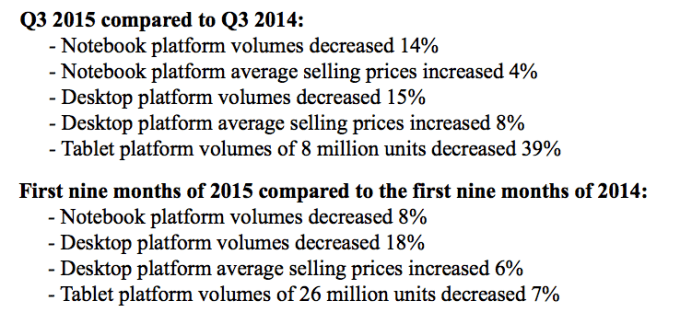
Please make the following sound with your face: Womp, womp. Here’s the breakdown via Intel’s release:
Screen Shot 2015-10-13 at 1.09.02 PM
That’s not so good. Keep in mind that the PC market is large, with many players. The above means that other OEMs, and participants like Microsoft, likely aren’t have a ball.
Guidance
Call it outlook if you will, but Intel expects revenue of $14.8 billion in the holiday quarter. Presumably a chunk of that will come from the traditionally strong PC sales cycle that takes place around Christmas.
Intel expects its gross margin to slip 100 basis points to a round figure of 62 percent. Those figures imply profitability not wildly different from the now-past quarter.
Intel remains a company in transition, looking to new revenue streams to supplement and replace falling PC incomes; the decline of its PC dollars is not Intel’s fault, per se, but is instead more of a reflection on the stale, and slipping PC market itself.
Shares of Intel are now mostly flat in after-hours trading.

Sunday, 19 April 2015

Intel Capital, Silicon Valley Bank chiefs see signs of a bubble

The heads of two of the most active startup investors in Silicon Valley — and most of the crowd that came to hear them Monday night — agree: There are clear signs that at least part of the venture-backed tech sector is overvalued.


Intel Capital President Arvind Sodhani and Silicon Valley Bank CEO Greg Becker devoted a good part of a Churchill Club appearance Monday night to the topic.

"In some areas I would say the valuations are pretty stretched," said Sodhani, whose corporate venture arm has scored the most exits by M&A and has secured the second most exits through IPOs since 2005, according to a recent report from PitchBook Data. "In some industries I have to ask myself if this is a software company or a services company?"

Software companies have traditionally sported higher valuations than services companies, but Sodhani said he is seeing the reverse in many cases today.

"I often have to ask myself if I am getting this wrong, but that is an area where I think valuations are stretched," Sodhani said, referring to services companies without naming any names. But he was quick to clarify that he isn't saying all companies bearing big valuations are undeserving of those lofty estimates of future success.

Hardware startups are pretty accurately priced, he said, because as data-intensive technologies like the Internet of Things, self-driving cars and drones take hold there will be a big need for the infrastructure that will make them work.

On a bubble scale of 1 to 10, Sodhani said he believes the market now is around a 6 or a 7. "That's not to say there aren't some 9's and 10's in there, or some 3's and 5's."

Becker, whose bank estimates it serves about 65 percent of all the region's startups and many of its venture firms, said he thinks the bubble needle is closer to a 7 or an 8, although he insisted that he isn't saying we're definitely in a bubble.

Becker has reason to focus on such things. His company’s stock fell more than 50 percent when the tech bubble burst 14 years ago.

"We have an office up on Sand Hill Road, and something I saw there recently was like it was came out of 1999," he said. "There was a tour bus in front of Kleiner Perkins."

"I'm also seeing a lot of companies with very healthy valuations of around $60 million or $70 million before they have any revenue, which is something we saw a lot of in 1999," Becker said.

There are also lots of companies which appear to be doing the same thing that all have big valuations, something Becker calls "copy companies."

When asked for a show of hands from the audience, a clear majority agreed with Becker's assessment.

Countering the worries about a bubble, Sodhani said that it costs much less now to build a tech startup than it did during the dot-com bubble, and the global market they can reach is much larger.

"Once upon a time, only the very largest companies like an Intel would ever think about selling in China," he said. "Now it's a lot easier, and in many industries that is a huge positive."

Becker said that previously companies like Uber or Airbnb would have been creating software to help the transportation or hospitality industries be more profitable. Now they are instead looking to disrupt the industries and are finding great success.

"Now they are saying we can destroy the way that an industry operates and change it completely," he said. "I think we are going to see more unbelievable companies formed in the next few years than we ever have in history, by a wide margin."

But the question for Becker is whether the valuations of those companies are correctly factoring in the risks of them successfully fulfilling their promise.

"Even great companies face great risks," he said.

Venture and late-stage investors have been enticed by the spectacular successes companies like Facebook and LinkedIn saw after going public, Sodhani said.

"There's a lot of capital trying to find the next Facebook, but we all know that there are only likely to be a half dozen Facebooks in the next decade or so," he said. "But the result is that everybody is chasing that big return and think they have found the next big, big win. I think that is dangerous."

Sunday, 12 April 2015

Intel CEO made $11M in 2014

Intel chief executive Brian Krzanich made $11.2 million in total compensation in 2014, according to Intel’s proxy statement released today.


Krzanich received $1 million in base salary, $3.2 million in an incentive cash payment, and $6.9 million in stock. That compares to $9.5 million in total compensation in 2013 and $15.8 million in 2012.

During 2014, Intel generated $55.9 billion in revenue, up 6 percent from $52.7 billion a year earlier. Its net income was $11.7 billion, up 22 percent from $9.6 billion in 2013. But the PC chip giant still faces challenges in breaking into smartphone and tablet chips to compete with rival Qualcomm. Intel’s market capitalization was $161.5 billion on March 3. That made it far less valuable as a company than Apple ($753 billion), but only slightly less than Amazon at $178 billion.

Krzanich has turned out to be a much more visible CEO for Intel than predecessor Paul Otellini. Krzanich has given talks at the Consumer Electronics Show two years in a row, and he even hosted a wearable tech fashion show in San Francisco. At the most recent CES, Krzanich announced that Intel would invest $300 million in diversity programs in an attempt to raise the number of women and minorities working in the tech industry and games.

Next month, he’ll host an event in honor of the 50th anniversary of Moore’s Law, which was conceived by Intel chairman emeritus Gordon Moore. Moore’s Law holds that the number of components on a chip doubles every two years. That law has held true, and it has become synonymous with technological advancement in the modern era.

EE Times/EDN 2014 Salary and Opinion Study

Overall, North American engineers are doing better salary-wise than their international peers, are satisfied with their careers, and are optimistic about the future. But concerns over the workload, job security, and the ever-constant changing landscape of the profession are causing some anxiety.

Explore the highlights of the 2014 Salary and Opinion Study in the charts and graphs that follow.


Monday, 6 April 2015

How Google, Facebook And Others Pay Their H-1B Employees

Legislative debate regarding expanding the H-1B visa program is heating up in the U.S. Senate. H-1B visas allow foreign workers — specifically those in technical roles—to legally work in the United States. In lobbying for an expansion of the current H-1B visa program, Google executive Eric Schmidt said, “We take very, very smart people, bring them into the country, give them a diploma and kick them out where they go on to create companies that compete with us.”

Amid this discussion, jobs at Google, Facebook and other tech giants have grown increasingly lucrative for Americans and foreigners alike.

An analysis of records from the Office of Foreign Labor Certification (OFLC) reveals that the median salary offered to H-1B applicants by some of the biggest tech companies — Amazon, Apple, Facebook, Google and Microsoft — is well over $100K and continues to rise.


Facebook has been the most lucrative company for H-1B visa holders thus far in 2015 (of the five companies above), with a median salary of $135K across all positions. But how do the companies stack up for specific roles?

By examining the most common professions among H-1B applicants for Amazon, Apple, Facebook, Google and Microsoft, five consistent career paths emerged across each company. Software engineers, systems software engineers, financial analysts, computer systems analysts and marketing managers make up a large part of H-1B visa applications.

Salaries for software engineers largely echo the overall trends, with Facebook offering the highest median salary and Amazon paying the lowest.


For financial analysts, we see the biggest outlier among all five job types, with Facebook’s median H-1B salary 46 percent higher than the next highest median salary (Microsoft).


Meanwhile, median H-1B salaries for computer systems analysts cover a much smaller range, with the most generous company (Google) paying only $23,100 more than the least generous (Amazon). The computer systems analyst role is also notable for being the only job for which Facebook is among the bottom two for foreign worker pay.


Foreign systems software engineers may want to avoid Microsoft, where we find our second biggest outlier. Microsoft pays these H-1B employees a median salary of just $82,828, 27 percent less than the next lowest paying company (Amazon).


For marketing managers, Microsoft once again places last, but the difference here is not quite as extreme as with computer systems analysts. Microsoft simply pays a median rate of 10 percent less than Amazon and Apple.


Finally, how do these companies stack up to other H-1B employers?

According to 2014’s salary distribution, they’re among the highest-paying, but certainly not the highest of all. About 7,000 H-1B applicants last year were offered salaries upwards of $200K.

You can see the distribution of H-1B salaries across all U.S. companies below.


Note: All data cited in this piece represents median salary information from H-1B visa Labor Condition Applications (LCAs). H-1B visa LCAs should not be confused with granted H-1Bs. After an LCA is approved, the company can enter their applicants into the H-1B visa lottery. Statistics on granted H-1B visas are not available through the OFLC.

Sunday, 1 March 2015

Samsung to freeze salaries in South Korea for first time since 2009


Samsung Electronics will freeze wages in 2015 for employees in South Korea for the first time since 2009, after the company saw its profits decline after seeing its smartphone sales drop due to rising competition from China.

"The measures are likely to inject a sense of crisis into employees, who have enjoyed steady wage increases and hefty bonuses in recent years," said Chang Sea-Jin, a business professor at Korea Advanced Institute of Science and Technology and author of the book "Sony vs Samsung".

Saturday, 28 February 2015

THE 25 BEST COMPANIES FOR INTERNS

The top internship program in America not only provide the eager students and recent graduates with high salary, but also a taste of real work experience and start to build up their network. For example, an intern in Motorola can earn as such as $4500.

Below is the Glassdoor's 25 Highest Rated Companies for Internships.


Saturday, 24 January 2015

How much does Apple company influences Engineer's take home pay check?


Apple company has always pay their employees well but how about the engineers from their supplier? If you don't get the chance to work in Apple, would you still be rewarded well for working with them as their supplier?

Indeed, it's does pay well if you work as their supplier, provided your company include stock option plan(SOP) as part of your total annual compensation. A lot of companies include SOP or restricted stock unit(RSU) as part of their employees total annual compensation.

Let's us take a look at Avago.


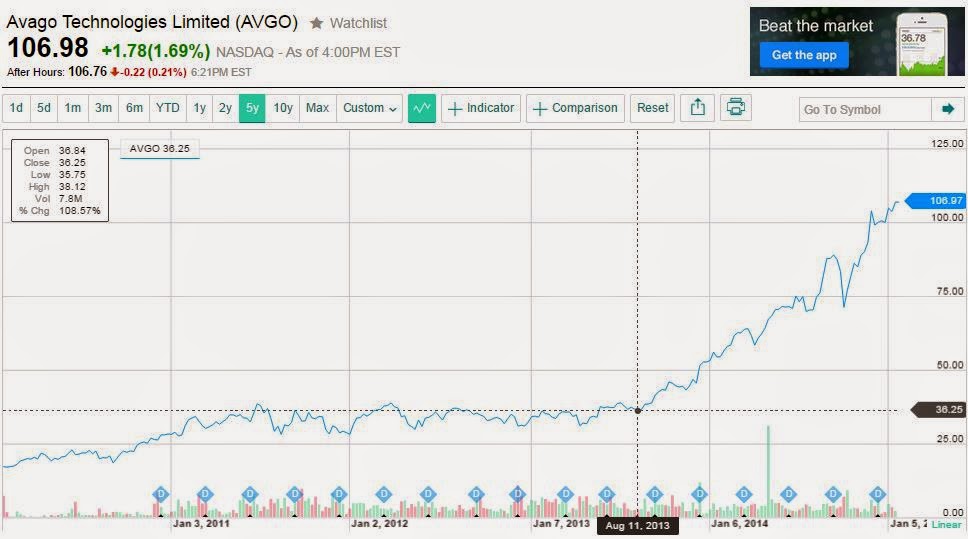
Ever since Avago get to a piece of RF chip business in Iphone6, their stock price increase exponentially. And the bull has no sign of stopping. 


Let's take an example of a senior engineer who just joined Avago 2 years ago and was given 2000 SOP at the starting of year 2013. And he was given another 2000 SOP at his 2013 year end performance review. So at Q1 2015, he would have total of 1500 SOP vested(25% of SOP vested every year). Based on the Avago stock price, how much he would earn?

If we assume the exercising price of SOP is $30, then each SOP will bring him around $80 of profit. Total 1500 of SOP will bring him $120,000. If we convert this to Ringgit, it would be staggering RM432,000 comparing to average annual income of RM80,000 that a senior engineer earned in Malaysia. And this is what's happening in Avago Malaysia right now!

Let's change the focus to manager. If a manager in Avago Malaysia is given 7000 SOP yearly starting year 2013 for easy calculation, how much would he take back home in Q1 2014?

Based on 25% of SOP vested yearly, he would have total 5625 SOP which amount to $450,000! This is around RM1.6 Million! Instant Millionaire!!!!  And he still going to have at least 5625 SOP vested for the next few years, this is crazy, isn't it?  

So the conclusion is that it is still rewarding to work as supplier for Apple if you don't get to work in Apple company, provided you join at the right timing. And it really show you how influence Apple is in impacting the take home paycheck for engineer from other company.